


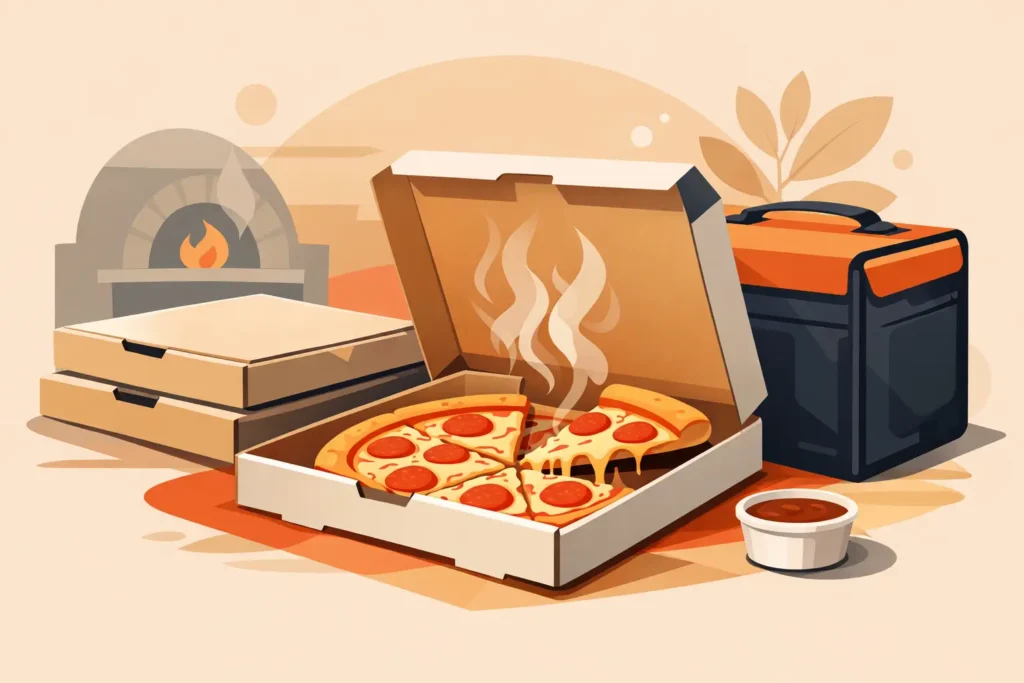
A pizza can leave the oven with a crisp base, melted cheese, and the right amount of color, then arrive at the customer’s door soft, greasy, and stuck to the lid. The difference is often the box. Pizza boxes for takeaway need to do more than carry a meal from counter to car. They need to manage heat and steam, protect the toppings, stack safely, and make a busy service run more smoothly.
For pizzerias, cafes, food trucks, bars, and caterers, the right box is a small operating decision with a visible effect on food quality and customer perception. A box that is too light, too tight, or poorly sized can create complaints that have nothing to do with the pizza itself.
What a Takeaway Pizza Box Must Do
A good pizza box has competing jobs. It should hold heat long enough for delivery or pickup, but it cannot trap so much steam that the crust turns limp. It must be rigid enough to protect the pizza during stacking and transport, while still being practical to store, fold, and buy at a sensible cost.
Corrugated cardboard is the standard for a reason. Its fluted inner layer adds strength without making every box unnecessarily heavy. It also provides some insulation, helping a hot pizza retain warmth on a short journey. The material is familiar to customers, easy for staff to handle, and available in common sizes that suit day-to-day takeaway service.
The lid matters as much as the base. It should close securely and sit high enough above the pizza that cheese and toppings are not pressed into the cardboard. A poorly fitting lid can rub against a high-crust pizza, make the box look untidy, and leave the customer opening a meal that has already been disturbed.
Choosing Pizza Boxes for Takeaway by Size
Size selection is where many operators either waste money or create avoidable food-quality issues. A pizza that slides around in an oversized box can lose toppings and arrive looking less appealing. A box that is too small can squash the crust and make loading difficult during a rush.
Start with the finished diameter of your pizzas, not the advertised size of the pan or dough ball. Allow enough room for the crust and a small clearance around the edge. If you sell a 12-inch pizza, a 12-inch box may be suitable when the internal dimensions comfortably allow for the finished product, but checking a sample is always worthwhile. Different box designs and board thicknesses can affect usable internal space.
Most takeaway operations benefit from keeping a focused range of sizes on hand. A small box for personal pizzas, a standard size for your main menu, and a larger option for family or sharing pizzas will cover most orders. If you offer extra-large pizzas, rectangular pizzas, calzones, or pizza-by-the-slice, choose packaging designed for those products rather than forcing them into a standard square box.
Stacking is another reason to use the correct size. Similar-sized boxes stack more evenly in the kitchen, on a delivery shelf, and in a driver’s insulated bag. That reduces the chance of crushed corners, tipped pizzas, and messy handoffs.
Check Height, Not Just Width
Thin-crust pizzas usually work well in standard-depth boxes. Deep-dish pizzas, loaded toppings, stuffed crusts, and pizzas with raised edges may need more lid clearance. If the cheese commonly touches the lid, the box is not doing its job, even if the pizza technically fits.
Run a simple test during a normal service period. Pack a finished pizza, close the lid, stack it with other orders, and carry it as a driver or customer would. When it is opened 15 to 20 minutes later, look at the crust, toppings, underside, and lid. That practical check will tell you more than dimensions on a product page alone.
Heat, Steam, and the Soggy-Crust Problem
Customers expect hot pizza, but hot does not automatically mean good. Steam is the challenge. As hot food sits in a closed box, moisture rises from the cheese, sauce, and dough. If that moisture cannot escape, it condenses inside the box and drops back onto the pizza.
Ventilation can help reduce excess moisture, particularly for pizzas traveling longer distances. Small vents allow steam to escape while the corrugated board continues to provide insulation. The best approach depends on your menu and delivery model. A thin, crisp pizza traveling 30 minutes may benefit from more ventilation than a softer, thicker pizza collected by a customer five minutes after it is boxed.
Do not assume that a fully sealed box is automatically better at keeping food warm. It may retain heat, but it can also retain the steam that ruins texture. The target is a pizza that reaches the customer warm with a crust that still has some bite.
Some operators use a small pizza saver, the plastic tripod placed in the center of the pizza, for heavily topped products or longer deliveries. It can stop the lid from touching the cheese if boxes are stacked or flexed. It is not needed for every order, and it adds another item to buy and manage, but it can be worthwhile when presentation is regularly affected.
Board Strength and Stackability Matter During Rushes
A box that feels fine when empty can fail once it holds a hot, heavy pizza. Extra cheese, meat toppings, thick dough, and family-size portions all add weight. If the board is too light, the bottom can sag when a customer holds the box one-handed or a driver carries several orders at once.
Look for boxes with clean folds, firm corners, and a base that remains level under load. A stable box protects the pizza and also gives staff confidence when moving orders quickly. In a busy kitchen, packaging needs to be simple. Boxes should fold without fighting the creases, close without tape, and stack without sliding apart.
Storage deserves attention too. Pizza boxes arrive flat, which saves space, but large bundles still need a dry, clean area away from grease, moisture, and food-preparation splash zones. Ordering the right quantity can be a balancing act. Buying in bulk often lowers the unit cost, while smaller orders can make more sense for seasonal sizes, new menu items, or businesses with limited storage.
Plain or Printed Pizza Boxes?
Plain kraft or white pizza boxes are a practical choice for many businesses. They are straightforward, cost-effective, and suitable when speed and consistency matter most. A clean plain box can still look professional when it is well assembled and free from grease marks.
Printed boxes create another opportunity. A logo, business name, ordering details, or simple message turns the box into a branded part of the customer experience. This is especially useful for independent pizza shops competing with larger chains, caterers serving events, and businesses that want their packaging to look as considered as their food.
Custom printing should be approached with the same practical mindset as any packaging purchase. Consider how often the design may change, how much storage you have, and whether the box will be used across multiple menu items. Small businesses do not always need a large production run to use branded packaging. Able Packaging can produce custom boxes in lower volumes, making it easier to test a design or order packaging that suits a growing operation.
Keep the design readable. A box does not need to carry every menu item, social account, promotion, and slogan. Your name, a clear logo, and a useful ordering message are often enough. Dark, heavy ink coverage can look striking, but it may not be necessary for a simple, affordable box that gets used every day.
Match the Box to Your Service Model
A walk-in pizza shop, a delivery-first kitchen, and an event caterer do not have identical packaging needs. Pickup orders may only be in transit for a few minutes, so folding speed and clean presentation could be the priorities. Delivery-focused businesses need to think more carefully about steam management, stacking strength, and how boxes perform inside insulated delivery bags.
If your pizzas are sent with sides, consider the full order rather than the pizza box in isolation. Garlic bread, wings, drinks, sauces, and desserts need to be packed in a way that keeps hot and cold items separate and prevents spills from reaching the pizza. A correctly sized carry bag or carton can make larger orders easier for customers and drivers to handle.
Before committing to a new box, test it with your busiest and most demanding order. Use the heaviest pizza, add the sides, stack several boxes, and recreate a realistic delivery time. If it survives that test, it is more likely to perform when Friday night service is moving fast.
The best pizza box is rarely the cheapest box or the heaviest box. It is the one that fits your food, works with your staff, protects the customer’s order, and makes commercial sense at the quantities you use. A few careful checks before ordering can help every pizza leave your kitchen looking like it should.