


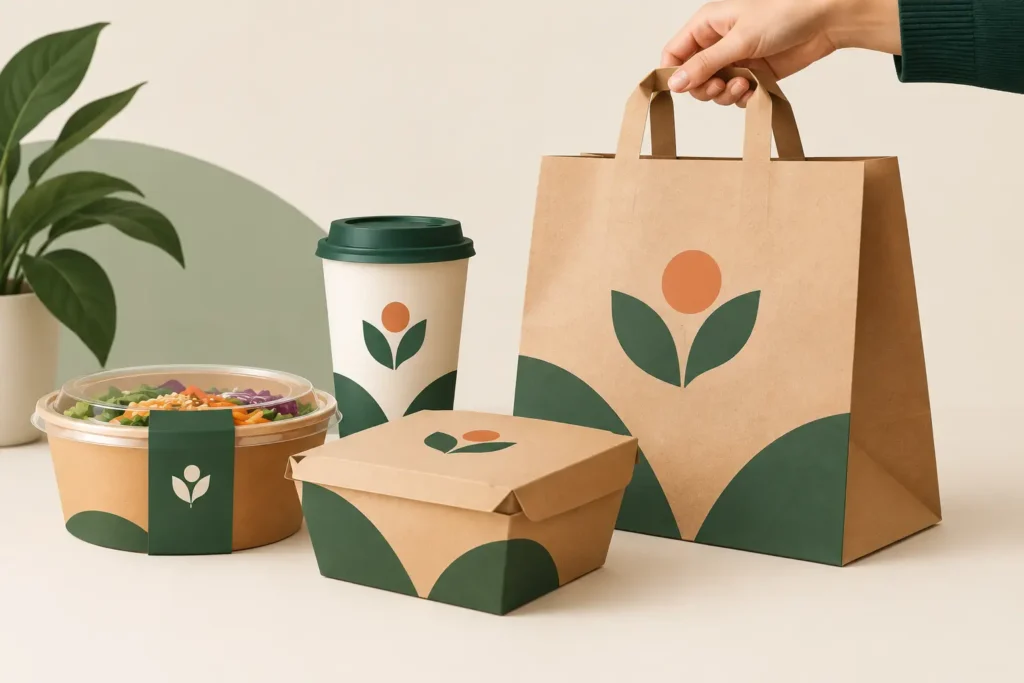
A plain food box gets the meal from your counter to the customer. A well-branded one keeps your business visible on the kitchen bench, in the office lunchroom, and in the photos people share. Knowing how to brand takeaway packaging is not about covering every surface with a logo. It is about choosing packaging that protects the food, works for your team, and makes your name easy to remember.
For cafes, restaurants, bakeries, caterers, and food trucks, the best approach is usually practical rather than flashy. Start with the pack your customers already need, then add branding where it will be seen and where it will hold up through heat, grease, handling, and delivery.
Start with the customer’s takeaway experience
Before selecting a box, bag, cup, or label, consider what happens after the order leaves your premises. A burger may travel 10 minutes in a delivery bag. A pastry box may sit on a meeting-room table for an hour. A family pizza box might be carried home, opened in the center of the table, and kept around until cleanup.
Those situations determine what packaging needs to do. Hot food needs ventilation and grease resistance. Cold drinks need lids that do not leak. Saucy meals need secure containers. Baked goods need protection from crushing. Your branding should sit on top of those requirements, not compete with them.
A small logo on a clean, sturdy kraft bag can look more professional than a full-color design on a bag that tears under the weight of the order. Likewise, a simple branded sticker can be a smart first step when menu items, container sizes, or order volumes change often.
How to brand takeaway packaging without overspending
The right branding method depends on how many packs you use, how often your menu changes, and how polished you need the result to be. There is no single best option for every food business.
Use printed packaging for your core sellers
Custom printed boxes, bags, cups, and food containers make sense for items you sell every day in consistent sizes. Think pizza boxes, burger boxes, pastry bags, coffee cups, or carry bags. These packs give your brand a built-in presence and reduce the extra handling involved in applying labels to every order.
Keep the artwork focused. Your logo, business name, a short message, and contact details are often enough. One or two print colors can look sharp, cost less than complex full-color artwork, and reproduce more reliably on kraft board or recycled paper.
Do not assume more ink means more impact. A design with clear contrast and enough blank space is easier to recognize at a glance, especially when a customer is holding a bag or opening a box.
Use stickers for flexibility and small runs
Printed labels are a practical choice for new venues, changing menus, limited-time promotions, and low-volume products. They can turn standard stock containers into branded packaging without committing to a large printed run.
A sticker is also useful for sealing tissue paper, closing paper bags, identifying dietary options, or adding a handwritten customer name. For delivery orders, a seal label does double duty: it reinforces your brand while showing the order has not been opened after leaving the kitchen.
The trade-off is labor. If staff are applying multiple labels during a busy service, the cost is not only the sticker. It is also the time, consistency, and chance of labels being missed. For high-volume orders, move your most common packaging to pre-printed stock when the numbers support it.
Add branded inserts where they earn their place
A small card, menu insert, or offer can work well for catering orders, gift packs, and higher-value purchases. It gives customers a reason to order again without crowding the outside of the pack.
Use inserts sparingly. A takeaway customer does not need a pile of promotional material mixed in with their meal. One useful message is enough: a reorder offer, catering reminder, social handle, or note about returning containers if your business uses a reusable-packaging program.
Choose packaging colors and materials that match your business
Your packaging should look like it belongs to your food and your venue. A premium dessert brand may suit a crisp white box with a refined single-color print. A sandwich bar or neighborhood bakery may be better served by natural kraft paper, bold labels, and simple black ink. A bright, family-focused pizza shop can use stronger colors, provided the logo remains readable.
Material affects the result as much as color. Kraft board creates a natural, straightforward look and can help hide minor scuffs in transit. White board gives colors more pop and suits detailed graphics. Clear containers let the food do the selling, while a branded seal label adds identity without covering the product.
If sustainability is central to your offer, be specific rather than vague. Choose packaging with the right recyclable, compostable, or recycled-content credentials for your local waste stream, then communicate only claims you can support. Food residue, coatings, and local collection rules can change how a pack is disposed of. “Eco-friendly” printed on a container is not helpful if customers do not know what to do with it.
Keep food safety and function ahead of design
Takeaway packaging has to perform under real conditions. Test samples with your actual food before committing to a design or a large order. Fill the container as customers receive it, close it, stack it, place it in a bag, and transport it. Check it again after 15, 30, and 45 minutes.
Look for grease showing through the board, condensation softening labels, chips losing crispness, lids popping off, and ink scuffing where boxes rub together. If the branding becomes unreadable after a short trip, it is not doing its job.
Make sure inks, adhesives, and printed surfaces are appropriate for food-service use. Printing generally belongs on the outside of food packaging, not on surfaces that touch food, unless the material is specifically made and approved for direct contact. Your packaging supplier and printer should be able to explain the material, print process, and suitable use.
Make the design easy to recognize from a distance
Customers should be able to identify your pack in seconds. That means your business name or logo needs to be placed where hands, folds, and delivery labels are least likely to cover it.
For boxes, the lid is usually the primary branding area. For paper bags, use the broad front and back panels, allowing for handles and folds. For cups, keep important information clear of seams and areas that will be covered by a sleeve. On delivery packaging, leave a clean panel for order labels, allergen stickers, and courier markings.
Use readable type. Fine script, pale colors, and tiny details may look good on a screen but disappear on textured board or at arm’s length. Ask to see a physical proof where possible. The difference between digital artwork and ink on corrugated board, kraft paper, or a coated container can be significant.
Build a packaging system, not a collection of random packs
Consistency is what makes modest branding look established. Your coffee cups, pastry bags, meal boxes, and carry bags do not need identical artwork, but they should share the same logo, colors, type style, and overall feel.
Start with the packaging customers see most often. For many food businesses, that is a carry bag, a main meal box, or a cup. Then extend the look to supporting items as stock turns over. This staged approach protects cash flow and prevents you from being left with old packaging after a redesign.
It also helps to standardize sizes where possible. Fewer box and bag sizes means simpler ordering, easier storage, quicker packing, and less waste. The goal is not to force every menu item into one container. It is to avoid buying six variations when three well-chosen options will do the job.
Plan the order around your actual volume
Custom packaging is more accessible than many small businesses expect, particularly when short-run printing is available. Able Packaging can produce low-volume custom printed boxes and carry bags with no minimum order quantity, which can suit businesses testing a new concept or adding branding gradually.
Still, print in sensible quantities. Work from weekly usage, storage space, seasonal demand, and how long your branding is likely to remain unchanged. Ordering too little can increase unit cost and create stock pressure. Ordering too much can tie up cash and fill valuable back-of-house space.
If you are introducing branded packaging for the first time, begin with one high-visibility item. Track customer comments, staff packing time, damage rates, and reorder frequency. That information will tell you whether to expand the range, change the material, or simplify the design.
Give customers a reason to notice the pack
Branding works best when it supports a good meal and an easy experience. A clean box that opens properly, a bag that carries comfortably, and a clear label that helps customers identify their order will do more for repeat business than decorative packaging alone.
Put your effort into the item customers handle most, make the design easy to read, and test it under the same conditions your food faces every day. When the pack is useful, reliable, and recognizably yours, it keeps working long after it leaves the counter.