


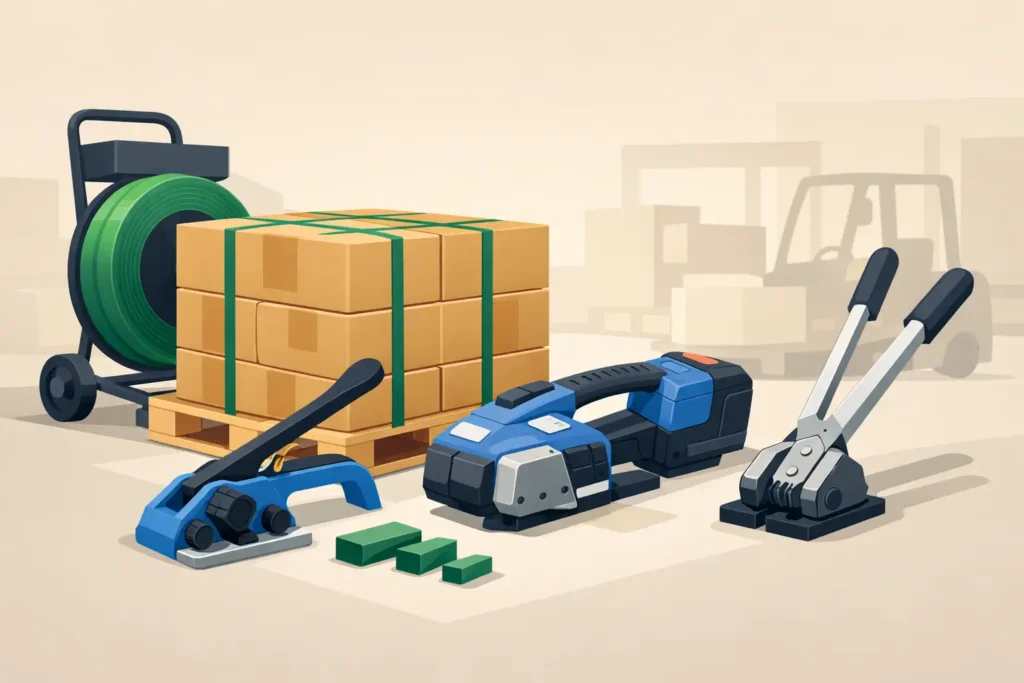
A pallet that shifts in transit usually does not fail because the strap was missing. It fails because the wrong tool, wrong tension, or wrong strap was used for the job. Choosing the right strapping tools for pallets is less about buying the most expensive option and more about matching the tool to your load, your shipping conditions, and how often your team straps pallets.
If you ship a few pallets a week, your needs are different from a warehouse banding loads all day. If you send fragile cartons, bottled products, or stacked cases that can compress under pressure, the wrong setup can damage the load before it even leaves the dock. That is why pallet strapping should be treated as part of load protection, not just a final step at packing time.
What strapping tools for pallets actually need to do
At a basic level, pallet strapping tools tension the strap, secure the seal or weld, and cut the excess cleanly. In practice, they also need to be easy for staff to use, consistent enough to reduce packing errors, and durable enough to hold up in a busy dispatch area.
A good tool should help your team apply the right amount of tension without crushing boxes or leaving the load loose. It should also suit the strap material you are using. Polypropylene, polyester, and steel all behave differently under tension, and the tool has to work with that material rather than fight against it.
That is where many buying mistakes happen. A business might focus on upfront price and ignore how the tool fits the actual load. Cheap tools can make sense for low-volume use, but they often slow down busy packing lines or create inconsistent strap tension across pallets.
Manual, semi-automatic, or battery-powered?
The right category usually comes down to throughput.
Manual strapping tools
Manual tools are a practical choice for lower-volume operations, mobile packing areas, or businesses that only strap pallets when sending heavier or less stable goods. They are more affordable upfront and generally simpler to maintain. For small retailers, independent brands, wineries, or operations shipping occasional pallet loads, manual tools can be enough.
The trade-off is speed and operator effort. Manual tensioners and sealers take more time per pallet, and results can vary between staff members. If several people are packing under time pressure, that inconsistency can show up in damaged loads or rework.
Pneumatic and semi-automatic options
These are more common in larger facilities where compressed air systems are already part of the setup. They reduce strain on staff and speed up repetitive work, especially when the same pallet format is being strapped over and over.
They do, however, tie you to a fixed work environment. If your team straps pallets in different parts of the warehouse or loading area, mobility becomes a problem.
Battery-powered strapping tools for pallets
Battery tools are often the sweet spot for businesses that need speed without installing a full strapping station. They tension, seal, and cut with much less manual effort, and they give more consistent results across different operators.
For growing warehouses and busy dispatch teams, they can save real time. The higher upfront cost is the main hurdle, but for many businesses the labor savings and cleaner, faster workflow justify it quickly.
Match the tool to the strap material
Not all pallet strap is interchangeable, and neither are the tools.
Polypropylene strap
Polypropylene is widely used for lighter pallet loads and general shipping applications. It is cost-effective and works well when the load is relatively stable and not especially heavy. Tools for polypropylene are common and usually more budget-friendly.
The limitation is that polypropylene has more stretch memory issues and is not always the best option for heavy loads or long transport runs where shifting and settling are likely.
Polyester strap
Polyester is a stronger option for heavier palletized goods. It holds tension better over time and is often chosen when loads are stored longer, shipped further, or exposed to more movement during transit. Many businesses prefer it as an alternative to steel for demanding applications.
The tool needs to be designed for polyester strap width and tension range. Using a tool that does not handle the material properly can lead to poor seals or uneven tension.
Steel strap
Steel is still used for very heavy, rigid, or industrial loads with sharp edges and high break strength requirements. It is less common in general warehouse and retail shipping, but in certain sectors it remains the right choice.
Steel tools are more specialized, and steel itself brings more handling risk. If your load does not genuinely require steel, polyester often gives a safer and easier-to-manage solution.
Tension matters more than most buyers think
When people shop for pallet strapping tools, they often compare tool types and strap materials first. That makes sense, but tension control is where performance really shows up.
Too little tension and the load can shift, lean, or loosen after movement. Too much tension and cartons can crush, product packs can deform, and corner damage becomes more likely. This is especially relevant for beverage cases, produce cartons, printed retail packaging, and any product packed in corrugated boxes with limited stacking strength.
A good strapping setup applies enough force to stabilize the pallet without turning the strap into a source of damage. That balance depends on load weight, carton strength, pallet pattern, and transport conditions. If your goods are stacked high or travel through multiple handling points, consistent tension becomes even more important.
Don’t ignore seals, friction welds, and accessories
The tool is only part of the system. Some tools use metal seals, while others use friction weld sealing. Each has its place.
Seal-based systems are straightforward and often suit manual operations well. They can be reliable and cost-effective, especially in lower-volume use. Friction weld systems, often found on battery tools, are faster and reduce the need for extra sealing consumables.
Then there are the accessories that stop good strapping from becoming bad load protection. Edge protectors, corner boards, and slip-resistant wraps all help distribute strap pressure and keep boxes from being cut or crushed. If pallets contain printed cartons, wine cases, food-service boxes, or anything presentation-sensitive, these extras are often worth using.
How to choose strapping tools for pallets in real operations
The simplest way to choose is to work backward from the load.
Start with weight. Heavy pallets need stronger strap and more controlled tension. Then look at the carton strength and product sensitivity. A dense, stable pallet of hardware can take a different strapping setup than a pallet of bottled goods packed in printed cases.
Next, think about volume. If your team straps five pallets a day, a manual tool may do the job well. If they strap fifty, labor time and fatigue start to matter. That is where battery-powered equipment often becomes the better value, even if the purchase price is higher.
Finally, consider the work environment. Are pallets strapped in one packing station or across multiple loading areas? Is your staff experienced, or do you need tools that are easier to train and harder to misuse? The best choice is usually the one that keeps the process fast, repeatable, and simple for the people actually using it.
Common mistakes when buying pallet strapping tools
One common mistake is buying for the heaviest possible load instead of the loads you ship most often. That can leave you with a tool that is oversized, slower, or harder to use for everyday work.
Another is focusing only on tool price while ignoring consumables and labor. A cheaper manual setup can cost more over time if it slows packing, causes inconsistent results, or increases damaged shipments.
The third is skipping compatibility checks. Strap width, strap type, seal style, and tension range all need to line up. If they do not, performance suffers quickly.
This is where practical supplier advice matters. A broad packaging supplier can help match the tool, the strap, and the load so you are not piecing together a system that looks affordable but performs poorly in use. That is the kind of real-world support businesses count on from Able Packaging.
When it is time to upgrade
If staff are spending too long strapping loads, if pallets regularly need to be redone, or if damage claims are showing up after transit, your current setup may be costing more than it saves. Upgrading does not always mean moving to the most advanced option. Sometimes it means switching strap grade, using better edge protection, or stepping up from a basic manual tool to a battery-powered unit.
The right strapping tools for pallets should make your packing process quicker, safer, and more consistent. They should help protect the load without adding unnecessary cost or complexity. If your current setup is fighting your workflow instead of supporting it, that is usually a sign it is time to make a better match.